 by
by In this guide, you’ll learn how to create and format a professional Gmail signature. You’ll find instructions on how to add pictures (logos, headshots, or banners) and how to turn social icons into clickable links. You'll also discover the fastest way to build your signature using Shared Email Templates & Signatures, along with best practices to make your design look perfect.
A simple signature block with your name and phone number is a solid starting point. However, while plain text is functional, it often lacks visual impact. To create a professional email signature, you should aim for a balance of information and design. Well-structured, it becomes your digital business card. Read on to learn how to transform your email signature into a powerful branding tool.
How to add a picture to your Gmail signature
Below is a standard method to insert an image into your Gmail signature through the settings. It’s easy and fast but limited: you only get three predefined sizes, and you cannot wrap text around the image. If you are looking for a free advanced fix to format your signature, you can use a layout table, or simply use the Shared Email Templates & Signatures extension for a professional yet effortless solution.
Note: This guide focuses on the structure and visual elements. If you need the basics – how to add, change, or turn off your signature – check out the guide on managing a signature in Gmail first.
Insert a picture directly into the signature settings:
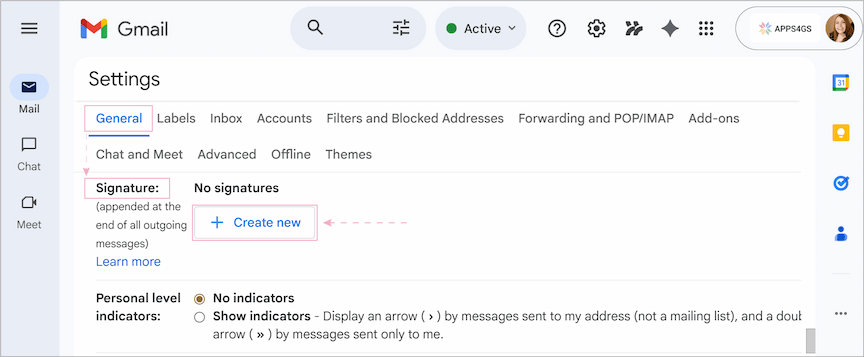
- Get to signature settings: go to the Settings > See all settings > General tab and scroll down to the Signature settings section.
- Choose the image location: place your cursor where you want the image to appear in the signature box and click the Insert image icon in the text editor menu.
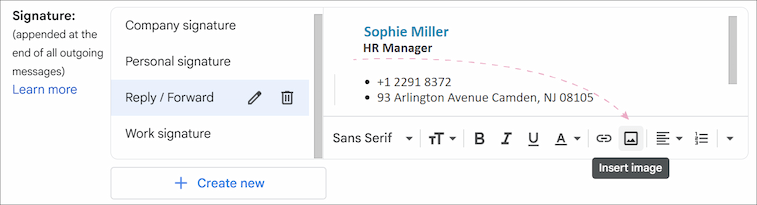
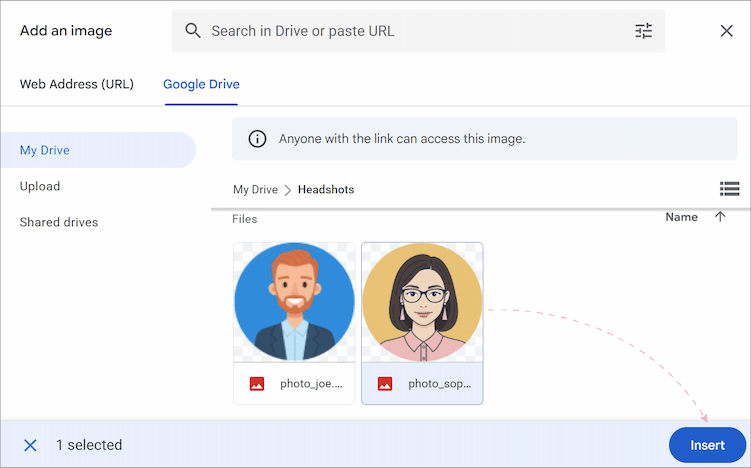
- Choose the image source: in the pop-up, select where your image comes from:
- Web Address – paste a URL if the image is already online somewhere.
- My Drive/Shared drives – grab something you've already got saved there.
- Upload – pull a file straight from your computer.
- Add the image: hit Insert, and the image drops right into your signature.
- Click Save changes at the bottom of the page.
Note: Click the + Create new button, if you haven't got a signature yet.
How to change the image size in a Gmail signature
To change the size:
- Click on the image. The cursor will appear as a blinking caret (vertical bar), but that is normal.
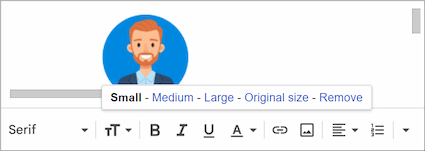
- A submenu will appear directly underneath the image.
- Select one of the available options: Small, Medium, Large, or Original size.
Note: If the built-in options are not enough for you, the only way to solve this is to insert a pre-formatted signature block (e.g. from Google Docs) or use a professional solution like Shared Email Templates & Signatures.
How to format a Gmail signature with a logo and links using a table layout
If you want to save yourself some trouble with text wrapping and image size, just create your signature in Google Docs first and only then paste it inside the Gmail signature editor.
How to wrap text and adjust size for a professional signature layout
To format an email signature with pictures using a layout table (e.g., in Google Docs):
- Open a new Google Doc.
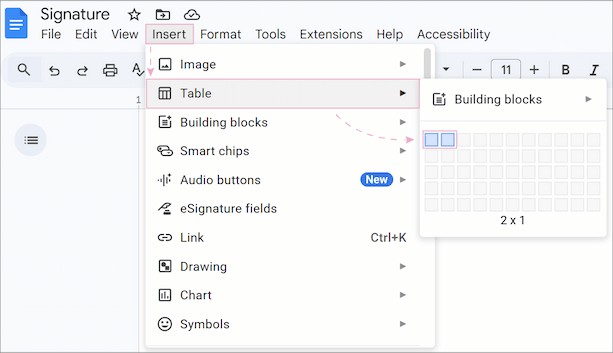
- Go to Insert > Table. Select a 2x1 grid.
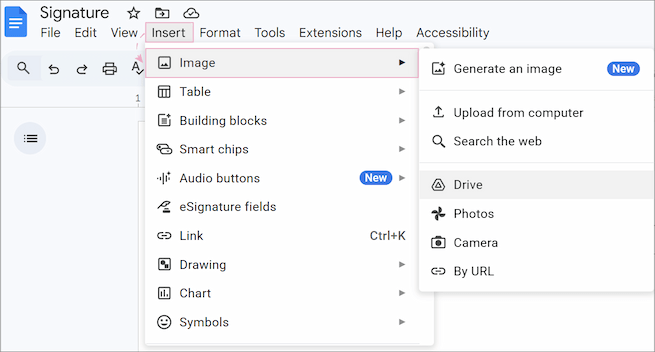
- Click in the left column, then Insert > Image. Find and upload your headshot.
Tip: If you want your photo in a circle, crop it in Illustrator, Photoshop, or Canva first.
- Type your signature text in the right column to align it next to your image. Fine-tune it the way you’d like to (e.g. fonts, colors, sizes).
Tip: Stick to Gmail-supported fonts, or Gmail will quietly swap them out for you.
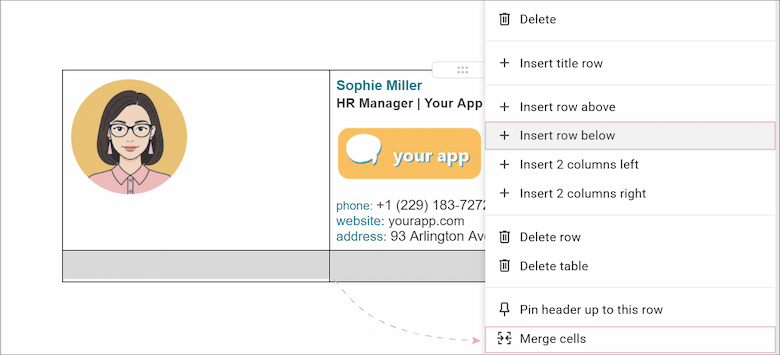
- Need a logo or banner? You can insert it inside your table the same way as a headshot. Or, put it in a separate cell: right-click the table and select Insert row below. Merge cells if needed.
- Drag the column borders until everything sits the way you want.
- To remove the table borders, highlight the table, click the Border width icon, and set the border to 0pt.
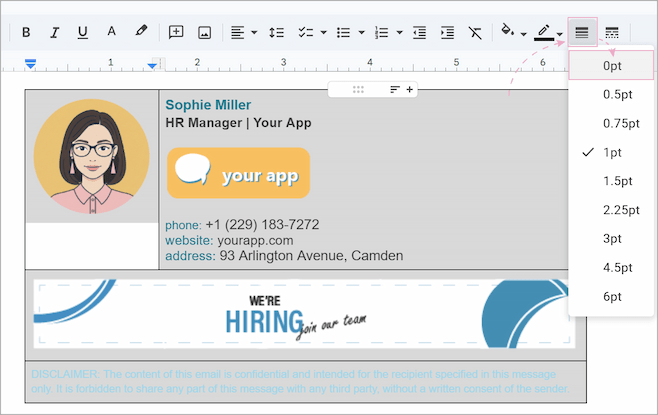
Now your signature layout is ready! You could copy and paste it into Gmail signature settings right now, save and use it as a signature block. But it’s still missing those interactive elements that make a signature truly professional.
So, before you move this table to the Gmail signature settings, read the next sections to include not only pictures but social icons and hyperlinks, too 😉.
How to add social media icons to an email signature
You could add them directly in Gmail's signature settings, but you'll run into the same alignment headaches as before. Way easier to put them inside the Google Docs table you already set up – same as you did with your pictures.
To add social media icons to an email signature, follow these steps:
- Download the icons themselves. You can find them on sites like Flaticon, Freepik, or Icons8.
Tip: Choose a unified style and size (usually 20x20px or 24x24px) so they look uniform.
- Return to your Google Docs table and add a new row/column/table for your social media icons.
Note: You can insert a new table for icons inside a big signature table, use one wide cell for all your icons, or give each icon its own individual cell to control spacing. Try different formatting options to find your style.
- Put your cursor in a cell, go to Insert > Image, and upload your icon. Repeat this for each one.
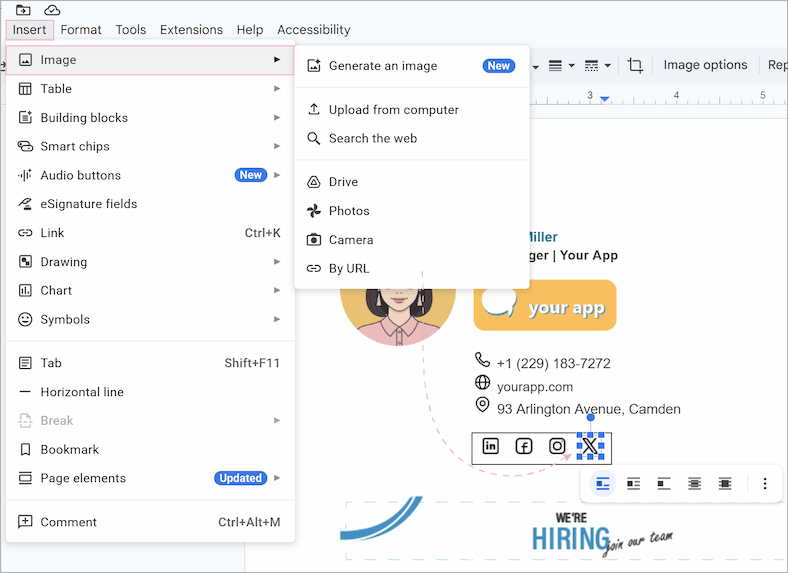
Tip: You can also add communication icons instead of typing "phone:" or "website:". A tiny phone or map icon makes the signature much easier to read and saves precious space.
Your social media icons are ready, the next step is to make them clickable.
How to make clickable icons for an email signature
Links are probably the most useful part of your signature. Whether it's your portfolio, a scheduling link, or your socials, you need to make them clickable.
To turn an icon into a link:
- Highlight the element in Google Docs.
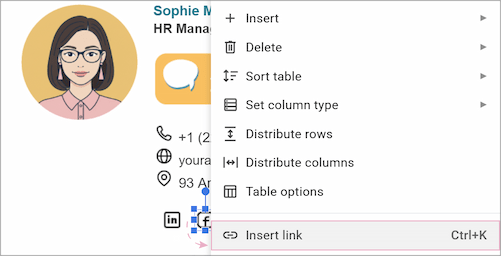
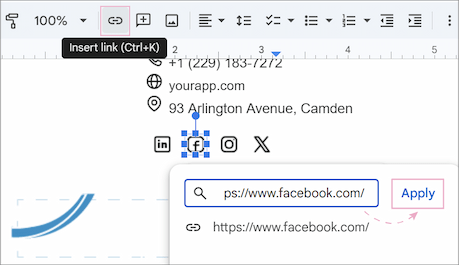
- Click the Insert link icon in the toolbar, or right-click your selection and choose Insert link.
- Paste your profile URL and click Apply.
Now you can copy and paste the whole table into the Gmail signature settings. Add it, set it as your default for new emails, hit Save, and your perfectly formatted professional signature is ready!
How to add a hyperlink to your Gmail signature in settings
If you need to add or change links later directly in Gmail signature settings:
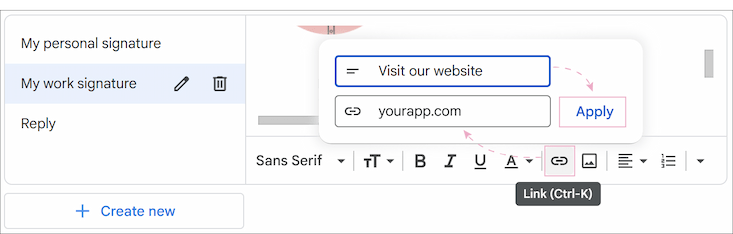
- Select the text or image in the editor.
- Click the Link icon.
- A small window will appear where you can add or edit the link destination.
- Hit Apply.
Don’t forget to scroll to the bottom and click Save changes.
Professional email signature for Gmail: The easy way
If you'd rather skip the whole manual formatting, there's a faster route. Shared Email Templates & Signatures is the best tool to create your custom signature in minutes, whether it’s a simple personal one or a complex company signature. Everything's already aligned, tested, and actually works with Gmail.
To set up your professional signature in seconds:
- Open the Shared Email Templates & Signatures pane right inside Gmail.
- Go to the Signatures tab and click New Signature.
- Browse the templates library and pick a layout that fits your vibe.
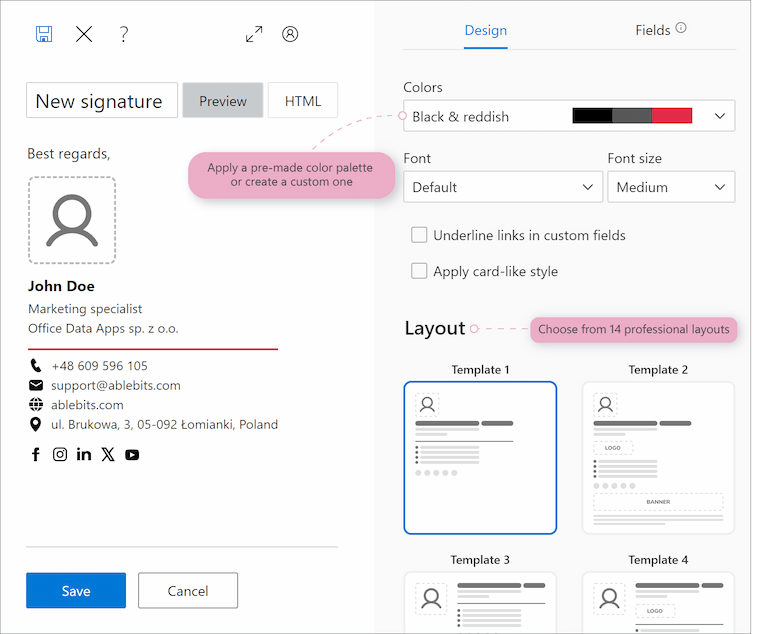
- Tweak the branding: colors and fonts are easy to adjust with a couple of clicks.
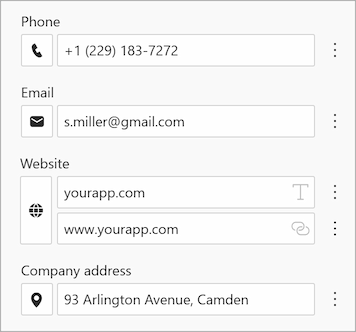
- Fill in your contact information. Add or remove fields depending on what information you want to show.
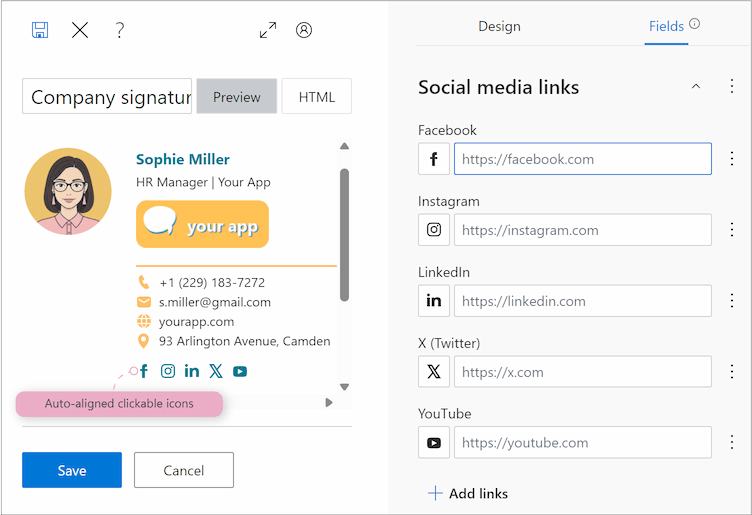
- All popular social icons are built-in. Just select the ones you need, add your links, and they’ll align and match your color automatically.
- Hit Save, and you're done. Your signature is ready to go.
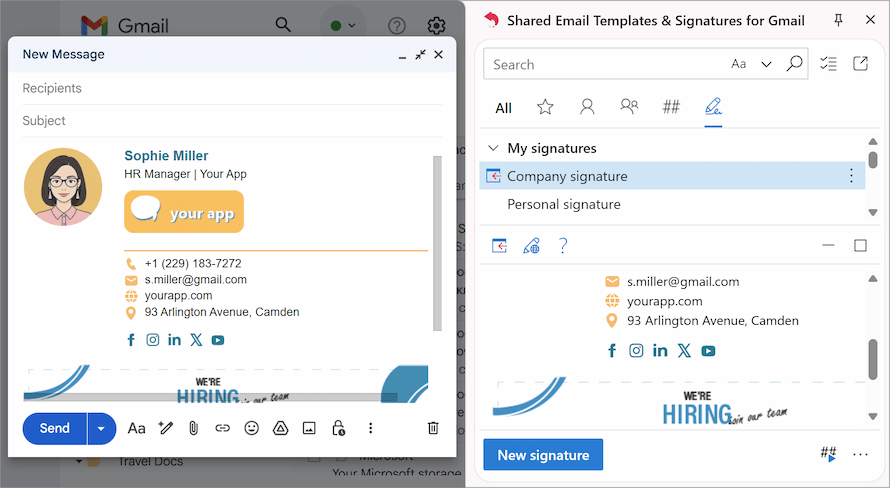
With Shared Email Templates & Signatures you can create as many signatures as you want, each tailored to a specific purpose. Just customize the layout, colors, and contact details and you'll have a professional email signature in your pocket.
Want to try it? Download the free trial and craft perfect signatures in minutes!
Best practices for professional email signatures
- Keep it simple. Don’t clutter your signature with every piece of information about yourself. Less really is more here.
- Make it easy to read. Throw in some dividers or white space between elements. It gives the eyes a break.
- Be careful with fonts. Stick to one or two simple, web-safe fonts like Arial or Helvetica. Bold your name or title if you want it to stand out, and use a smaller font for legal info.
- Add some color. Pick colors which are closely associated with your brand, but not more than three. You can search for a color palette to make sure they match.
- Optimize images and banners. High-res is good, but keep the file size under 30kb. Your signature shouldn't weigh a ton. Images should be optimized so they load quickly.
- Use standard image formats. We recommend JPG, JPEG, PNG, or GIF files for logos and icons. Use consistent sizing, and always include descriptive alt text in case images don’t load.
- Test it on mobile. Plenty of people read emails on their phones, so make sure your signature stays readable on a small screen. Simple layout, clean text, and icons big enough to tap.
- Place key information at the beginning. Contact details should appear at the top of the signature. Banners or promotional content should be placed below.
- Use Shared Email Templates & Signatures. The most reliable way to manage signatures is to use a dedicated tool like Shared Email Templates & Signatures. With Shared Email Templates & Signatures, you just pick a layout, plug in your info, and let the tool handle the work for you.
Why is my Gmail signature image shown as an attachment?
Reason: A signature image often appears as an attachment when it is embedded as a file within the email rather than being linked as a clean external reference. This happens because direct insertion in Gmail, pasting from Google Docs, or using certain third-party generators can convert images into MIME attachments, which many email clients treat as downloadable files.
Solution: The most robust fix is to stop using pasted or embedded images. Instead, rebuild your signature using images hosted via a public URL.
Note: With a URL-based image, some recipients may not see it automatically because of their email client's settings. Gmail, for example, allows users to choose between "Always display external images" and "Ask before displaying external images." It may also block images from suspicious senders.
So the tradeoff is:
- Embedded images: Display more reliably but are likely to appear as attachments.
- URL-based images: Rarely appear as attachments but are more likely to be blocked until the recipient allows them.
Why is my Gmail signature image not showing up?
Reason 1: The most common cause is that the image is hosted externally and Gmail does not load it automatically. This usually happens when "Ask before displaying external images" is enabled, or when Gmail considers the sender or message suspicious. Google scans messages for suspicious content; in such cases, images may be hidden until the user allows them. For more details on how this setting works, see Google’s "Turn images on or off in Gmail" help page.
Reason 2: The image source itself might be the issue. The image may no longer be accessible, its Google Drive sharing settings may be incorrect, or browser cache and cookies could be interfering. Additionally, browser extensions might block the image, or the file itself could be too large or poorly formatted. Google recommends keeping signature images 70–100 px tall and 300–400 px wide, with a strict maximum height of 100 px.
Solution: First, ensure your own Gmail is set to "Always display external images." Then, double-check your image size, as Gmail often fails to render oversized images in a signature block.